Permian Basin in dire need of power
Levi Hill/News-Sun
The Delaware Basin of Southeast New Mexico is starving.
Every economic development opportunity that could possibly come to New Mexico — from nuclear facilities, including upgrades at Urenco USA, to data centers — all need one thing: Power.
And it is power New Mexico is lacking in spades. How much? Potentially as much as 20,000 megawatts of power, according to James Lackey, director of Customer Relations at Xcel Energy.
Lackey was one of two guest speakers at the New Mexico Energy, Minerals and Natural Resources Department’s Comprehensive Energy Transition Strategy workshop Wednesday in Hobbs.
The meeting was the first of several going on around the state to identify paths forward to meet the state’s growing need for energy.
Xcel, which serves southeast New Mexico and West Texas, in in the throes of a major shortage of power generation driven mainly by oil and gas, but also growing demand from data centers, agriculture and even national defense.
“The same power we are asked to generate, this same power powers Cannon Air Force Base, the drone programs, hospitals,” Lackey said. “This power is vital for all of us. We can’t just cut it off at the knees. It is for everyone.”
Lackey said Xcel even serves Pantex in Amarillo, which builds nuclear weapons for the U.S. government. That facility wants to expand, but Xcel cannot build power fast enough to meet their needs, he said.
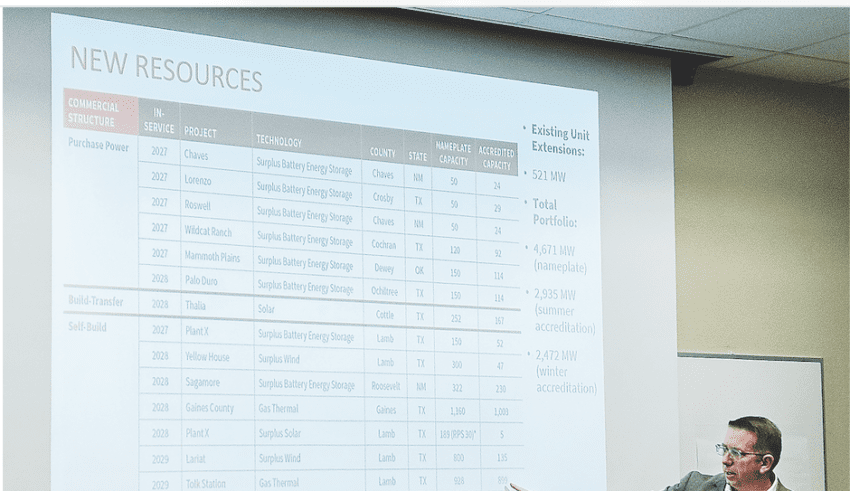
“In 2023 we identified 14 new projects with 4,671 additional megawatts of power to meet our growing demand,” Lackey said. “Today, in the Delaware Basin, I can supply 4,519 megawatts of power and can import to a peak load of 6,387 megawatts. We have 13,951 megawatts of load waiting to be served. By 2035, our unserved load could exceed 20,000 megawatts. Power is needed no matter who the customer is.”
He said Xcel is currently in hearings with the New Mexico Public Regulatory Commission to build out 3,000 more megawatts of power, but it is happening too slow.
“The process is very arduous,” he said, adding the 14 projects identified in 2023 totaled an estimated build-out cost of $9 billion.
“If that were with no new thermal units (just renewable) then the cost goes up by another $5.5 billion,” Lackey said. “(Renewables) are extremely expensive on initial capital investment. Having a baseload power is the challenge for transition to renewables.”
In New Mexico and Texas, small and large industrial users make up 80 percent of all Xcel accounts. In states like Colorado and Minnesota, industrial users account for only 20 percent of all customers.
Xcel serves 128,000 customers in New Mexico. Lackey said 47 percent of Xcel’s power sales go to New Mexico and 50 percent to Texas. The remainder is wholesale sales.
The lack of power is one that Mewbourne Oil in Hobbs is familiar with. Erin McMath with Mewbourne talked about the company’s need for power at the workshop.
“Oil industry uses a tremendous amount of electricity,” he said. “Ten years ago all the jobs were mechanics, now it is electricians.”
McMath said Mewbourne gets 168 megawatts of power for its oil fields from Xcel. However, the company has another 233 megawatts Xcel cannot supply and is supplied by on-site natural gas-fired generators.
“We have over 300 small generators employed and the downside is they are natural gas generators and not as efficient as a large-scale plant,” he said. “A natural gas plant built here today would reduce our emissions even if it is not 100 percent renewable.”
He said Mewbourne is on a waiting list for power from Xcel and will likely continue to supply its own power through on-site generation for at least another decade.
And that seemed to be a big part of Wednesday’s discussion. New Mexico wants to supply the nation with power, but refuses to rethink its approach.
In her state of the state address earlier this month, Gov. Michelle Lujan Grisham claimed New Mexico could power the nation.
“New Mexico has enough energy to power the entire United States. That is not just oil and gas,” she said on Jan. 20.
However, her eye is focused on what she calls “clean energy,” which overlooks natural gas. As was pointed out Wednesday, the state has dropped its greenhouse gas emissions by 21 percent since 2005, but most of that came from carbon reduction by shutting down coal-fired power plants and transitioning to natural gas-fired power plants.
One attendee pointed out several nations around the world are looking to reclassify natural gas power as a “clean” energy source, something New Mexico has been reticent to do.
Interim cabinet secretary of EMNRD Erin Taylor said the state has reduced methane emissions by 95 percent since 2018, forcing oil and gas companies to capture and sell the gas.
“We generate half the emissions of Texas,” Taylor said. “How do we do that? By complying to the methane waste rule set forth by Gov. Lujan Grisham.”
Taylor kicked off the meeting with announcing the EMNRD’s vision for the meetings — to follow the governor’s goal toward a clean energy future.
“Why do we need a transition? Because it is already happening whether we know it or not,” she said. “We need to act now to develop strategies for an all of the above policy that will drive down emissions.”
Other topics discussed at the meeting included: produced water desalination, EV cars versus hybrid cars for the rural portions of the state, the need for better school infrastructure, a lack of “affordable” housing, the need for more power transmission lines and reclassifying natural gas as a clean fuel.
The next EMNRD CETS meeting will be held Feb. 11 in Farmington and the topic will be electrical grid stability.