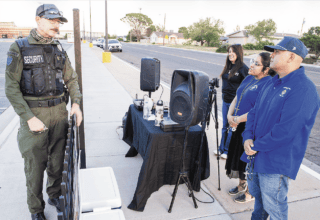
Oil theft a booming industry for thieves
Levi Hill/News-Sun
The recent arrest of five men as part of a “large-scale” oilfield theft ring involving a Mexican cartel is shedding light on a booming crime business plaguing the Permian Basin on both sides of the state line.
“About 96 percent of the (property) crime in Lea County is oilfield,” said Rex Fleetwood, investigator with the Lea County Sheriff’s Department. “We have multiple cases going on throughout the county and West Texas.”
When asked if he could put a price tag on the total thefts, Fleetwood said it would be difficult to add up because the amount is so large and the number of cases so big.
“It is a lot. I’m not sure we can track how much we are losing,” he said. “For 2024 and up to the first few months of 2025, I have 59 oilfield theft cases on my desk in Lea County alone,” he said, adding that investigators from counties across southeast New Mexico and West Texas as well as federal investigators are working in tandem on cases because it is often the same thieves operating across state lines.
The most recent bust, announced by the Department of Justice on Sept. 29, netted five suspects in an alleged oil theft ring authorities say is responsible for multiple millions of dollars worth of stolen oil.
Maxwell Jensen, Thomas Rees, Christopher Ortega, German Ortiz-Santillano and Christian Jesus Contreras Varela are in federal custody, charged with interstate transportation of stolen property and aiding and abetting. The men face 10 to 15 years in prison, if convicted.
Contreras Varela, a Mexican national, faces additional charges for being an immigrant in possession of a firearm.
The DOJ said in a news release the group stole “millions of dollars” worth of crude oil throughout the scheme but did not give a total amount.
According to court documents, special agents with the Bureau of Land Management opened an investigation in June after receiving information the five men were involved in a scheme to steal crude oil from Plains All American Pipeline facilities in New Mexico, store it at a yard in Carlsbad, and transport it into West Texas for resale.
Fleetwood said LCSO was involved in the case, providing surveillance and gathering evidence.
“It happened in less than 60 days,” he said. “That is the fastest federal case I’ve ever seen go.”
Surveillance operations, tracking devices and recorded conversations documented more than 20 theft runs over approximately four weeks, reportedly siphoning hundreds of barrels per day. Each load was valued at tens of thousands of dollars.
A recent survey of 33 oil and gas executives by the Dallas Federal Reserve Bank showed 41 percent had their operations affected by oilfield theft in the past year.
Crude oil theft topped the list of items stolen with 61 percent of respondents stating they’d had crude oil stolen in the past year. Piping, valves and wiring was the second-most reported target, with 58 percent of respondents identifying those items as being taken.
However, more than 75 percent of respondents said the effect of the thefts on the company was “low.”
Fleetwood said most thefts of oil run around 300 barrels — or about $17,000 a load at current prices — but the thefts are occurring in multiple locations over the course of days and weeks to the point it is beyond some smaller oil companies to contend with.
“I know one independent (oil company) that had to sell out because of theft,” Fleetwood said. “I was working two different cases involving this company as a victim. Someone stole $1 million worth of pumpjacks off their wells.”
He said when oil is stolen the company not only loses the revenue, but also must still pay royalty taxes on the oil extracted — a double whammy on the financial burden of the thefts.
When it comes to equipment theft, he said the damage done by the thieves can and often does double the loss. In the case of the $1 million in pumpjacks stolen, the total damages to other equipment done was an additional $1 million, he said.
Oilfield theft is an everyday, vast, criminal enterprise that encompasses the entire region, with criminal groups working huge areas and often targeting smaller producers who have less money to invest in security than larger, international companies.
“I have a case now where we are looking at $7.5 million in oil theft and that’s just one person,” Fleetwood said. “Some of these cases are much bigger. It is a lot more organized than people realize.”
In fact, Jensen, 25, and his father, James Jensen, 68, were charged in May with conspiring to financially support a Mexican cartel — Cartel de Jalisco Nueva Generación — which was designated a foreign terrorist organization in February.
The Jensens, according to a DOJ release, allegedly operated Arroyo Terminals, a Texas oil company, and “aided and abetted the fraudulent entry of approximately 2,881 shipments of the oil in violation of the Tariff Act.”
At the time of the Jensens’ initial arrest, federal authorities seized four tank barges with crude oil and three commercial tanker trucks, according to the news release. An indictment stated the United States will seek a $300 million judgment against the Jensens upon conviction.
“Cases like this highlight the often-dangerous relationships between alleged unscrupulous U.S. businesses and terrorist organizations,” said Special Agent in Charge Craig Larrabee of Immigration and Customs Enforcement’s Homeland Security Investigations San Antonio in a released statement.
Fleetwood said he began work on the Jensen case in 2020 before it was eventually turned over to federal investigators.
“They were stealing six tankers worth every month or so,” he said. “They were stealing from us, Eddy County, Loving County — down to Crane and up through Midland and Andrews.”
In the most recent arrest, Rees managed the Carlsbad yard through his company, Hound Dog Energy, where he received and sold stolen oil while producing fraudulent load tickets to disguise the thefts. Ortega directed truck drivers, prepared false documentation, and recruited additional participants to expand the conspiracy.
Ortiz-Santillano, an employee of Plains All American Pipeline, abused his position to provide the conspirators access to pigging stations where the thefts occurred.
Contreras Varela drove to the pipeline to connect a vacuum truck and steal the oil before returning to Rees’s yard. Jensen coordinated the scheme as the leader and organizer.
The FBI launched an investigation into the oil scheme on June 18 after receiving a tip from a confidential source that a group was planning to siphon oil from a pipeline facility in New Mexico, store it at a yard in Carlsbad and then resell it in Texas, according to an affidavit filed in U.S. District Court for the State of New Mexico.
The FBI said surveillance operations documented more than 20 transports of oil from New Mexico to Texas over a four-week period.
Fleetwood said the volume of cases is more than any one department can handle and more funding and more investigators are needed to keep up with the caseload.
“We are working on establishing a task force,” he said. “There are more than enough cases for five or six of us. I work across three counties through the District Attorney’s office and I’m even working in Texas. If they are stealing near us, they are going to hit us next.”
Beyond that, he said stiffer penalties for thieves are also needed, something law enforcement in the region is pushing for.
“We are trying to get the state to change the criminal damage laws to be similar to a larceny law,” he said, adding cases with less than $500 damage are charged as misdemeanors. Law enforcement wants to see them become fourth-degree felonies and anything with more than $20,000 in damage become a second-degree felony.
Patrick Melvin, Chief Deputy District Attorney for the Fifth Judicial District, said oilfield theft is an extremely serious crime.
“We understand the role oil and gas production plays,” he said. “It is not just a property issue; it is a threat to worker safety and a threat to our economic stability. We strongly support stronger penalties for these crimes.”
Melvin said the Fifth Judicial’s caseload is the second highest in the state after Albuquerque. But staffing is always an issue as attorneys can make more money in the private sector than in public service, making cooperation key to success in combating oilfield crime.
“There is and has been a strong cooperation between the sheriff’s offices and our federal partners in combating this,” he said.
Fleetwood said fighting oilfield crime is an expensive endeavor.
The Lea County Sheriff’s Department spent $1 million in grant funding on a license plate-reader camera system designed to help catch oil thefts as they are moved in and out of the county by truck.
In February 2023, Sheriff Corey Helton, told Lea County Commissioners about the camera system. Helton said oilfield thefts during the last two years — including tools, copper wire, trailers and large equipment — amounted to more than $5.7 million.
That number didn’t include lost production revenue, or actual theft of oil.
“We are, unfortunately, spending a lot of money on this,” Fleetwood said. “Luckily, I have partners. I’ve partnered with nearly investigator around this county. Our communication string has been extremely beneficial.”
Still more manpower and money are needed to reach the level of enforcement Fleetwood envisions for Lea County.
“We are really going to have to pick up some manpower and get some money to really get it rolling,” he said. “I want to get to the point where the thieves look at Lea County and say; ‘We aren’t going over there.’”