Gas production climbs faster than oil in Permian
Levi Hill/News-Sun
WASHINGTON, D.C. — Natural gas production in the Permian Basin is growing faster than oil production and it is creating a bottleneck. Solutions are coming, but too slowly.
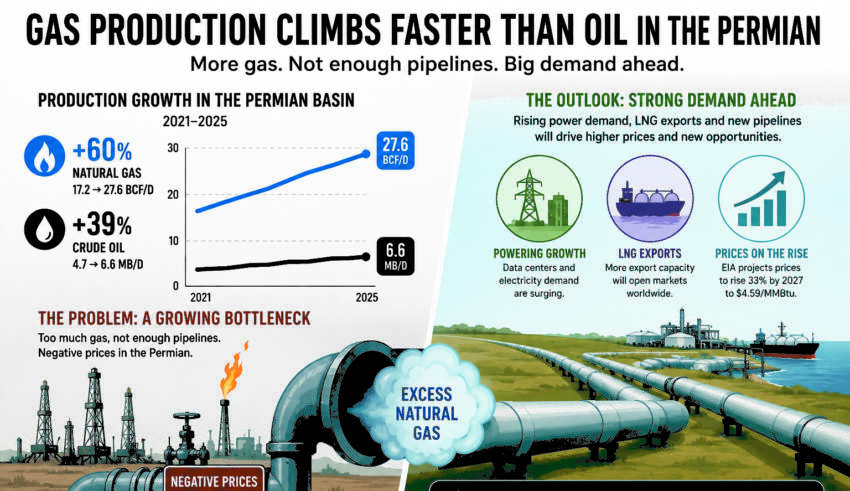
According to a recent report by the U.S. Energy Information Administration, marketed natural gas production in the Permian Basin grew by 60 percent from 2021 to 2025, up from 17.2 billion cubic feet per day to 27.6 b/cfd.
During the same time, oil production grew by 39 percent, up from 4.7 million barrels per day to 6.6 mb/d.
“The higher growth in natural gas production is the result of increasing gas-oil ratio,” the report read. “The gas-oil ratio in the Permian Basin has steadily increased in the last five years. As the GOR rises, we estimate the production growth rate of natural gas will continue to exceed the growth rate of crude oil in the Permian region.”
In 2025 the ratio averaged nearly 4,200 cubic feet of natural gas per barrel of oil for an increase of 16 percent from 2021. EIA said the ratio will likely continue to increase as the basin matures.
A similar report from the American Petroleum Institute shows U.S. gas production up 27 percent since January 2019 with Texas, New Mexico and West Virginia accounting for 94 percent of the net growth.
Texas has led on a volumetric basis while New Mexico has led by percentage, surging 168 percent since 2019. These three states now account for 47 percent of total U.S. natural gas production, up from 35 percent in early 2019.
Glut is a price killer
However, the Permian has a problem.
The glut of excess natural gas coming from the region’s oil-seeking wells and a lack of pipelines to move the gas to regions of demand is driving prices down.
For the last two years, the Permian has been the only U.S. oilfield recording negative prices for its gas. In recent weeks, those prices have dipped below negative nine dollars per thousand cubic feet — among the lowest in recent history.
Earlier this month at the ninth Lea County EnergyPlex Conference, Ken Waits, president of Mewbourne oil, the second largest private oil producing company in the country, said oil companies are working to bring more oil to market but the abundance of unwanted natural gas is indeed a problem.
“We are trying to do everything we can to bring oil to the market,” Waits said. “Part of the challenge is natural gas prices here were negative $4 in April.”
Waits said the company is bullish on natural gas going forward.
“We are very bullish for natural gas long term. We have a lot of natural gas in this country. I do think there is an opportunity,” he said. “There are pipelines coming online in the next year, but there is a need for more. Texas is a pretty darn friendly place to do business, but the challenge is getting gas to the coast.”
Demand is there
In February, the EIA said it expects prices to remain flat in 2026 before rising in 2027 because of increased natural gas consumption worldwide for electrical power grids.
“LNG export capacity and increased natural gas consumption in the electric power sector are expected to drive stronger demand, push storage inventories below the five-year average, and put upward pressure on prices by outpacing production growth,” the EIA report read.
EIA estimated the Henry Hub natural gas spot price will average $3.46 per million BTU this year — a two percent decrease from $3.53 in 2025 — and then rise by 33 percent to $4.59 per million BTU in 2027.
In April, research firm Wood-MacKenzie — talking about demand for Rocky Mountains gas — forecast US gas demand to grow by 40 billion cubic feet per day by 2035, creating significant supply opportunities traditional sources alone will be unable to meet.
“Even without taking into account LNG exports, the West South Central region (Arkansas, Louisiana, Oklahoma and Texas) will account for 30 percent of that demand, redirecting Permian gas away from the West Coast and creating a competitive opportunity for Rockies gas supply to step in,” the company’s report read.
In January, Global Energy Monitor, a San Francisco–based nonprofit that tracks oil and gas developments, released its findings on the demand for gas-fired power in light of the boom of AI data centers which have nearly tripled the demand for gas-fired power in the US over the past two years.
“Building all the gas-fired power infrastructure that was in development at the end of last year could increase the US gas fleet by nearly 50 percent,” according to Global Energy Monitor’s findings.
The US currently has around 565 gigawatts of gas-fired power on the grid. If all the projects in the development pipeline are built, it would add almost 252 gigawatts of gas power to the US fleet.
James Lackey, director of Customer Relations at Xcel Energy, said late last year the company already lacks enough power to supply local demand with several regional data centers in the works.
Xcel, which serves southeast New Mexico and West Texas, can supply 4,519 megawatts of power and can import to a peak load of 6,387 megawatts. Demand currently sits at 13,951 megawatts and by 2035 the demand is expected to exceed 20,000 megawatts, Lackey said.
Xcel recently received approval to build two gas-fired power generation facilities in Texas to serve its 128,000 New Mexico customers.
But it will be years before there is enough power to meet demand.
Erin McMath with Mewbourne, said the company gets 168 megawatts of power for its oilfields from Xcel. However, the company has another 233 megawatts that Xcel cannot supply, with the extra demand met by on-site natural gas-fired generators.
“We have over 300 small generators employed and the downside is they are natural gas generators and not as efficient as a large-scale plant,” he said. “A natural gas plant built here today would reduce our emissions even if it is not 100 percent renewable.”
He said Mewbourne is on a waiting list for power from Xcel and will likely continue to supply its own power through on-site generation for at least another decade.
Pipelines, pipelines and more pipelines
Matt Pawlowski, vice-president of NextEra Energy, said NextEra’s parent company is the number one buyer of natural gas in the nation. The two biggest hampers to development in the country is a lack of pipeline infrastructure to move gas to the coast and a lack of electrical power generation lines, he said.
In January, Chicago-based financial services firm Morningstar said strong demand for natural gas is driving a surge in pipeline construction across Texas, Oklahoma and Louisiana. Morningstar said 12 new and expanded natural gas pipelines are scheduled to be completed this year. They are expected to add 18 Bcfd of capacity.
Three pipeline projects expected to be completed this year would increase the area’s export capacity by about 20 percent. Two of those will lead to a gas hub near Corpus Christi and one to a hub at the center of Dallas–Fort Worth’s proliferation of power-hungry data centers for artificial intelligence, according to a report in Texas Monthly. By 2029, another three are slated to come online.
According to the PBPA, the demand for Permian Basin natural gas is improving.
“U.S. LNG export capacity continues to expand, and Permian gas — via the Gulf Coast — feeds directly into that market. LNG developers have emphasized the importance of long-term, low-cost supply, a description that fits West Texas gas even after transportation costs,” a PBPA report reads. “Natural gas in the Permian Basin in 2026 is unlikely to deliver headline-grabbing prices, but it is increasingly indispensable. As oil drilling continues, LNG exports expand and power demand from data centers and AI infrastructure rises, Permian gas is moving from byproduct to pillar. For industry professionals, the opportunity lies not in betting on price, but in mastering scale, efficiency and market access in a gas-rich future.”
The EIA said 66 percent of 44.9 billion cubic feet per day of new pipeline capacity coming online in 2026 and 2027 originates in Texas.
“The projects in Texas will provide additional takeaway capacity out of the Permian Basin and debottleneck the Waha hub, supplying natural gas to LNG export terminals as well as residential, power and industrial users,” the EIA reported.
The largest of the Texas projects under construction include Rio Bravo, a 138-mile pipeline with capacity of 4.5 Bcfd that will deliver feedgas to NextDecade’s Rio Grande LNG export terminal; Blackcomb, a 365-mile pipeline with capacity of 2.5 Bcfd to deliver Permian supply from Waha to Agua Dulce; and Hugh Brinson, a project of 2.2 Bcfd for Permian takeaway.
Finding uses at home
In fact, companies are finding uses right here in the Permian Basin for the abundant natural gas.
Houston-based Chevron reported recently its subsidiary Energy Forge One signed an agreement with Microsoft Corp. to develop a co-located power facility in Reeves County to fuel a new data center.
The massive gas-fired power plant, Project Kilby, is expected to deliver about 2.67 gigawatts of capacity for one of Microsoft’s largest data centers.
The Pecos campus will expand Microsoft’s global data center footprint by about 2 gigawatts and represents a multibillion-dollar investment. The first power delivery is expected in 2028.
In February, news came a $1.6 billion clean fuels manufacturing facility is slated for the Lovington Industrial Park with the potential to create 107 jobs and $4.6 billion in economic impact.
The project comes from Houston-based Blue Pony Energy — a chemical manufacturing company specializing in synthetic, low-carbon products — and would use natural gas as a feedstock to produce its products.
“A lot of what we make is not made in the U.S., it is imported,” said Justin Rencurel, chief executive officer of Blue Pony Energy. “We are an early-stage project.”
According to a news release from the New Mexico Economic Development Department, Blue Pony “aims to produce low-carbon products for the evolving energy landscape.”
Rencurel said the products are made from natural gas.
“We need natural gas. It is our primary feed stock,” he said. “We are using existing technology that is very prevalent in other processes. We produce thin gas — we break apart the carbon and four hydrogen atoms and make it into a longer-chain molecule. We do the same thing with crude oil to make various types of products. Some is transport fuels and some is lubricants and other industrial products and then feed stock to other industrial processes. What we can make is unique, bio-degradable, high-purity products.”
Rencurel said Lea County is a good fit because of the abundance of oil and gas.
Gas production will keep climbing — probably
Natural gas production in the area is likely to keep growing as well. Oil companies are drilling fewer wells, but investing in technology to extract more oil from existing wells, including new hydraulic fracturing technologies that are expected to increase the amount of oil recovered from underground reserves.
Currently a well, on average, returns 10 percent of all the reserves underground,
Randy Sinclair, senior manager of investor relations for Chevron, said oil demand globally is expected to grow by one percent each year until 2035.
“There is no shortage of demand for the product we produce,” Sinclair said, adding 2024 and 2025 both set record years for demand. “Gas demand is growing even faster than oil.”
He said technology is the future for oil and gas production as oil companies are finding new ways to extract oil from legacy wells instead of drilling.
He said new chemical technology is jumping the amount of oil recovered from 10 to 11 percent — the number may seem small until it is applied to all of the some 75,000 active oil and gas wells in New Mexico. With increased oil recovery comes increased natural gas recovery.
“The next decade unlocks a lot more promise in this space,” Sinclair said. “We have doubled the rig efficiency of our rig fleet. We have seen a really amazing evolution in fracture technology in the last few years. We can frack three wells at the same time now.”
A recent report by the API shows more than half of Permian wells were completed simultaneously last year.
U.S. operators in the Permian region of Texas and New Mexico completed 3,600 wells in 2025 using simultaneous hydraulic fracturing — a technique that minimizes completion crew time on well pad sites by completing two wells simultaneously.
Operators in the Permian completed a total 6,800 wells — 13 percent more — in 2025 than in 2024.