AG targeting oilfield crime
Levi Hill/News-Sun
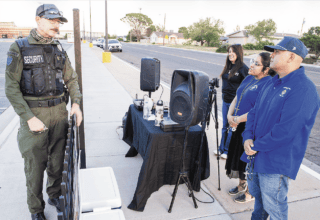
Oilfield crime is an organized and booming business and it has caught the eye of New Mexico Attorney General Raul Torrez, who was in Hobbs Tuesday to meet with local and Texas law enforcement to look at ways of protecting the life blood of the region.
In September, five suspects were arrested in an organized oilfield crime ring in Carlsbad that allegedly stole millions of dollars worth of crude oil. The group was reportedly tied to a Mexican cartel and had further connections to another series of thefts in Texas that totaled an estimated $300 million.
In February 2023, Sheriff Corey Helton told Lea County Commissioners about a county-wide camera system monitoring vehicle license plates. Helton said oilfield thefts during the last two years — including tools, copper wire, trailers and large equipment — amounted to more than $5.7 million.
A recent survey of 33 oil and gas executives by the Dallas Federal Reserve Bank showed 41 percent had their operations affected by oilfield theft in the past year.
Crude oil theft topped the list of items stolen with 61 percent of respondents stating they’d had crude oil stolen in the past year. Piping, valves and wiring was the second-most reported target, with 58 percent of respondents identifying those items as being taken.
Most thefts of crude oil run around 300 barrels (the capacity of a tanker truck). At today’s price of oil one truckload would total about $17,000 in lost oil.
Lea County Sheriff’s Department investigator Rex Fleetwood told the News-Sun earlier this year that oil and copper wiring are not the only items taken — entire pumpjacks have disappeared from locations.
“I know one independent (oil company) that had to sell out because of theft,” Fleetwood said. “I was working two different cases involving this company as a victim. Someone stole $1 million worth of pumpjacks off their wells.”
In that case, the total damages to other equipment totaled an additional $1 million, he said.
Torrez said his goal in Hobbs is to see what local law enforcement needs to fight this rising tide of organized crime.
“So, we are here because we’re trying to meet with local law enforcement and leaders inside the oil and gas industry to try and come up with a strategy to deal with this crime,” he said. “We’re really trying to get a better understanding of both the scale of the problem and then listen to some of the experts coming from the Texas side.”
Torrez said Texas has law enforcement task forces dedicated to fighting oilfield crime and he envisions something similar for New Mexico, possibly funding it through a redirect of a portion of oil and gas tax revenues.
“What we’re trying to do is bring industry and law enforcement together, bring some experts from different states and different jurisdictions to try and learn from them,” Torrez said. “We are looking at revising or proposing new legislation to deal with this particular type of crime.”
Torrez said the talk is adding a specialized enhancement to oilfield crime because it targets the nation’s energy infrastructure, as well as handling oilfield theft like recent changes to retail crime, where cases against one suspect are lumped into one larger case, increasing the penalties.
“I think we are looking at potentially expanding the model that we have for organized retail crime into this energy infrastructure theft,” he said. “We also want to talk about resource needs and coordination between private industry and law enforcement. It’s my understanding that at least some of the larger operators, they have cameras and artificial intelligence. It’s about evaluating those leads, ensuring that information is being shared with law enforcement in a timely manner.”
“The hope is that we can start increasing intelligence sharing and information and start coming up with legislative proposals looking at resource needs, and then putting us in a position where we can better safeguard this critical resource for not only this community, but for the nation,” Torrez added.
He said the state has a racketeering statute that is being looked at as well.
“That will enable us to focus in on criminal conspiracies that are operating as an enterprise and it allows us to build a criminal case against an entire organization at one time rather than a one-off criminal event,” he said.
“I think you’ve got some really dedicated local law enforcement agents who have been dealing with this problem for some time and they just haven’t had the level of support and the help they need from the state. So that’s part of my role in this is to try and be an advocate for the issue in Santa Fe. But in order to do that, I’ve got to educate myself,” he said. “I’ve got to educate myself about what the real needs are from the industry’s perspective, but most importantly from the local law enforcement perspective and then just get them the tools that they need. So, I mean it’s going to be a long-term investment in a long-term project, but I think it is something that is probably desperately overdue.”
In other important local topics, Torrez spoke briefly about the recent departure of the Holtec long-term nuclear waste storage facility from a site in Lea County after Governor Michelle Lujan Grisham and state legislators opposed the project.
In January, Torrez’s office even filed a joint amicus brief supporting the Fifth Circuit Court of Appeals’ ruling against a license issued by the Nuclear Regulatory Commission to Interim Storage Partners, which would allow for storage of nuclear waste in Texas near the New Mexico border. The brief reflected the NMDOJ’s continuing efforts to prevent the NRC’s issuance of both the ISP license and a license for Holtec International
“The hardships that would be endured by New Mexicans in the construction of these nuclear waste storage facilities in and near our state would be monumental,” Torrez said in January. “…our office is dedicated to fighting against the impact of such waste storage in New Mexico.”
Tuesday, Torrez didn’t have much to say on the project, only that he’d seen they had prevailed in their litigation and the company had pulled up stakes in New Mexico.
However, his thoughts on produced water and recent developments in reuse, such as a recent announcement a company in Texas had begun extracting lithium from produced water, were encouraging for Lea County.
“I’ve obviously got to be concerned about health impacts, environmental impacts, but frankly, I think that conversation should be led by the scientific community and it always helps to have that research,” he said. “So that seems to me like a very sound, long-term investment that we need to be making, but I don’t have enough information about the science. But what I will say is; I’d like to hear from them more before I get, you know, bogged down in the politics and policy side of it. And sometimes we don’t do that in a lot of different areas, right? We should really focus in on what the science says about things and make sure that those the people that are doing that work have the resources that they need.”