Eunice ‘ground zero’ for N.M. screwworm response
Levi Hill/News-Sun
EUNICE – Eunice is ground zero for New Mexico’s first active response to the resurgence of the New World screwworm after it was officially eradicated from the country nearly 60 years ago.
A dog was found to be infected with the flesh-eating parasite on June 8, prompting New Mexico Livestock Board, Game and Fish and local officials to immediately coordinate a 12-mile quarantine zone around the community and begin livestock inspection and trapping protocols to stamp out the fly and its larva before they get a foothold.
The fly was officially pushed as far south at central America in 1966 after a 45-year battle to eradicate the fly from North America and Mexico.
The fly, which has a 30-day life cycle, lives off plant matter until the female is ready to breed. The female then finds a living organism on which to lay eggs. Within 12 hours the eggs hatch and the almost microscopic larvae begin eating living tissue. Within 7 days the larva grow to nearly half an inch in length and can severely damage or kill their host.
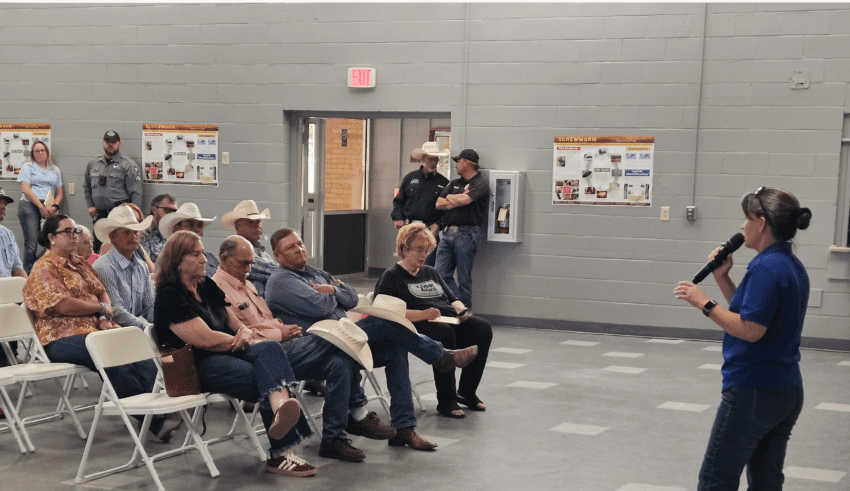
Samantha Holeck, state veterinarian for the New Mexico Livestock Board, addressed a tense crowd of some 60 area ranchers Thursday in Eunice, saying the dog found infected in Lea County might lose an eye and the state is adapting to the challenge of combatting the fly, which has made a terrifying jump from Central America to the U.S. in just two years.
“We are all trying to relearn what this whole thing is about,” Holeck said. “I have personally never had to deal with it, but my mom and dad did. It can be a really devastating thing.”
Holeck said a few outlier cases of the worm were found in Texas in the 1970s and 1980s, but it was officially wiped out in 1966.
For a fly that Holeck described as “lazy” — refusing to fly over open water, typically does not climb altitude and cannot fly well in high winds — its progression north has been staggering.
“It made its way back to the U.S. in two-and-a-half years, which is a pretty aggressive return,” she said.
The next closest confirmed case of screwworm in the United States is in Tom Green County, Texas, near San Angelo, nearly 200 miles from Eunice. There have been 12 confirmed cases of the screwworm in the U.S. to date, all in Texas except the Eunice case.
“We are still trying to understand why we just have one,” Holeck said, adding the fly’s progression north has come from larvae hitching rides on infected animals. Once through their seven-day feeding cycle, the larvae drop out of the host and burrow into the ground where they mature before re-emerging as flies.
Holeck said New Mexico will be a poster child for how the nation responds to the fly’s reinvasion.
“As hard as everyone is looking at Texas, they are looking at our state a lot more. Veterinarians from the western states are looking at what we do to set the precedent for the rest of the western states, because no one really expects to do things quite like Texas does,” she said. “There are ways to treat it now that we did not have before. The biggest part of our plan is continuity of business.”
The quarantine around Eunice will continue for 21 days beginning from when the dog has fully healed, Holeck said. However, surveillance of the area will continue for another 90 days, three life cycles of the fly.
Traps went out Friday around Eunice for mature flies, hoping to determine if there are more in the area. Holeck said how there is only one case in Eunice so far is a mystery.
Barry Allen, chief law enforcement officer for the New Mexico Livestock Board, said Eunice has been the best place for the first case to happen, if it had to happen at all.
“It happened in the right place for us,” Allen said. “We got the training right here with great people. We handled this one pretty good, the next one will be even better. We got this.”
For area ranchers concerned about how the quarantine will impact operations, Allen said continue business as usual, watch your livestock and pets for signs of them not acting normally and plan ahead.
“We are going to take care of this, and we are going to be here for you,” he said. “Do not start treating now or they (the fly larvae) will develop a defense against your treatment. Don’t just start treating everything now. Maintain that resistance to the products we have. Communication is the key to success — plan ahead. We want your product to bring the best possible price it can bring. You need to know the state of destination before you ship your livestock. We have been training for this a long time. We will have boots on the ground, get your cattle inspected and get you moving.”
One rancher at the event said afterwards ranchers are worried, but it is one of those challenges that must be met.
“I live north of Eunice about three miles. Unfortunately, I am in the zone, but it doesn’t bother me. It is just one of those deals, there is nothing we can do about it,” he said.
Holeck said the Mexico and the U.S. are ramping up responses to the fly. The most successful has been breeding sterile male flies in captivity that are released in zones where non-sterile females are active.
The result is the female lays unfertilized eggs and the species dies out. It is the very procedure used to push the species out of the U.S. 60 years ago.
“There is a facility in Mexico right now that should be open by the end of July that will start off production of 35-50 million flies per week with total production expected to reach 100 million a week within 6 months,” Holeck said. “Construction has started on another facility in Texas. That facility is starting from scratch and will not be available until 2027. 300 million flies per week is the target goal there.”
The plan is to hit the flies along the main leading edge of their zone in Central America and Mexico hard.
“Once the leading edge moves beyond Central American and Mexico, they are no longer getting sterile flies. Geographically, it is just not a barrier we can hold very long,” Holeck said.
Anyone finding an infected animal should immediately contact a veterinarian, the livestock board or game and fish officers. Larvae can be placed in a jar of isopropyl alcohol and turned over to inspection.
What makes the fly larvae so terrifying is they can be quietly eating away the flesh beneath the skin with no external indication of infection, Holeck said.
“They are finding cows with larva inside the mouth, in a fold of skin, in the ears,” she said. “When they hatched they are not much bigger than a tick and full size they are less than half an inch.”
Holeck said it is basically impossible to identify the fly by looking at it as it resembles a native species of screwworm that feeds only on dead flesh instead of living tissue like the New World screwworm.
“We need a cold winter to shut down the lifecycle of that fly,” she said. “Fly bait does not attract screwworm flies. It requires a special type of lure that stinks very, very badly. They eat plant matter until they lay eggs. It is very rare to see the fly. They do not hang around the animals for very long. The males eat plants and the females only hang out around animals long enough to lay their eggs. Basic wound care is the best thing you can do with animals to prevent being targeted by the fly.”
On June 10, Agriculture Secretary Brooke Rollins appeared before the U.S. Senate Agriculture Committee to report on the status of the screwworm’s resurgence in the country.
Rollins said the previous administration ignored the threat and the Trump Administration has invested $1.3 billion in combating the screwworm, increasing staffing from 10 to 120 inspectors, significantly expanding sterile fly dispersal capacity and deploying more than 8,000 traps and more than 57,000 screenings along the border.
Both the Department of Health and Human Services and the Food and Drug Administration approved nine emergency use authorizations and three conditional approvals for animal drugs to prevent or treat New World screwworm in multiple species. In February, a previously closed sterile fly dispersal facility was opened at Moore Air Force Base in South Texas.
In April, the nation broke ground on a new sterile fly production facility also in South Texas.
New World screwworm poses minimal risk to humans. According to U.S. Agriculture Department, most people in the U.S. face very low risk.
Since the outbreak began spreading through Central America and Mexico, more than 2,000 human cases have been reported there, compared with more than 171,000 animal cases.
Most U.S. human cases have involved travelers returning from affected countries.
Practical precautions recommended by the CDC: Keep all wounds clean and covered; seek medical attention for wounds that suddenly worsen, smell foul or contain visible larvae; use insect repellent and protective clothing if traveling in affected areas and monitor pets and livestock for unusual wounds.
For more information on the screwworm, visit www.screwwormnm.org for updates on the quarantine and a map of infected areas. Residents can enter their address into the website to see if they are in a quarantine zone.
Holeck said combating the screw worm today comes with challenges, but also tools not available six decades ago.
“They did not have ivermectin or the medications we have now and they didn’t have the movement controls,” she said. “Our country, our industry has been through this before and we will get through it again. It is a marathon, not a sprint.”