Air Force vet turned airline pilot enjoys soaring for relaxation
PETER STEIN/NEWS-SUN
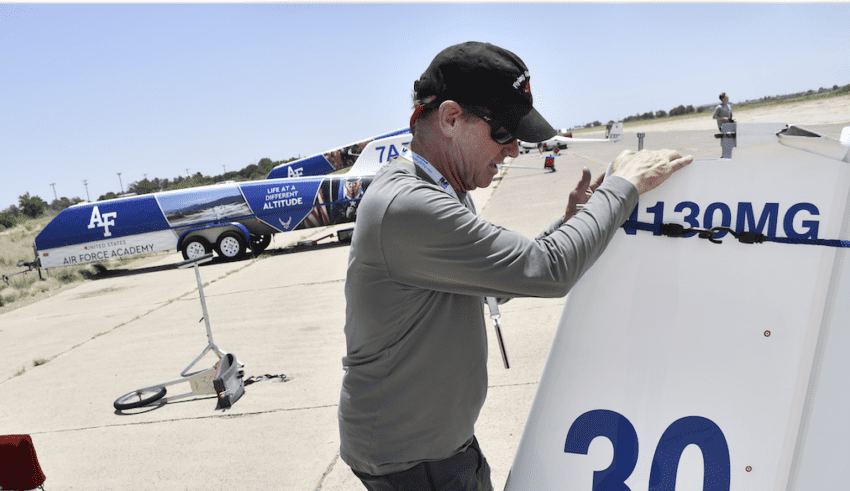
As an Air Force Academy graduate and a seasoned commercial airline pilot, Brad Peterson knows about being grounded.
So when it happened on Thursday during the Standard Class Nationals soaring competition at the Hobbs Industrial Air Park, and Peterson wasn’t able to take his JS1 glider up for another day in the skies due to the potential of inclement weather, it wasn’t anything he hadn’t experienced before.
Peterson of Boulder, Colorado was still happy to be out at the airfield. Once a regular glider, he put the hobby aside as he pursued careers in military and commercial aviation, and just a year ago he returned to his recreational aviation pursuit.
“Went back to gliding, yup,” Peterson, a 1985 Air Force Academy graduate, said as he was finishing putting his glider away, Thursday at the Hobbs Industrial Air Park. “I’m coming up on retirement from United Airlines. I tried several other hobbies, so now I’m back to my wheelhouse.”
For Peterson, gliding has been a lifelong love, which began when he was 12 years old.
“My dad was racing old gliders back in the 70s,” Peterson recalled. “I was just a kid, and I learned how to glide.”
And Peterson has seen a lot in his years of gliding.
“It’s really quite amazing what electronics has done the last 40 years,” he said. “You used to have to do a lot of the calculations in your head. Now electronics can do a lot of the calculations, plus 30 more things.”
Peterson’s high-tech 21st-century equipment can do just about everything, including advising him of any nearby thermals, which are invisible columns of rising warm air.
“That’s the whole sport,” he said, “cruising fast and finding a thermal. The stronger the thermal the better.”
Peterson says for every mile up in the air, a glider can go 60 miles. “Here in Hobbs,” he said, “you can get two miles up and can glide 120 miles.”
Wind in this region can be a hazard to some other hobbyists, but not so much for gliders, according to Peterson.
“You don’t really feel the winds at altitude,” he said. “You feel turbulence, but you don’t feel the wind. And once you start to circle, the turbulence goes away too, because you’re moving with the air mass, not against the air mass.
“You’re not allowed to have live weather (updates),” Peterson added. “That would take all the guess work out of it.”
Peterson said that the glider pilots meet at the Soaring Society, usually around 10 a.m. before each competition, and are given their task for the day. Though they couldn’t get up in the air on Thursday, the Wednesday task involved soaring from Hobbs to Tatum, to Monument, to Denver City, to Hamilton, to an abandoned air field, then back to Hobbs.
“Fairly short,” Peterson said, “but it was 133 miles.”
Soaring adds a little more excitement than flying a commercial airliner, according to Peterson. “Most airline flight designs are mundane,” he said, “which is good because we don’t have many accidents.”
Soaring, says Peterson, can get a little dicier but offers more freedom.
“You can land anywhere,” he noted. “You can land in an airport or a farmer’s field.”
As of early Thursday afternoon, Peterson had his feet planted safely on terra firma. But it’s usually not long before he’s back in the sky, which is just how he likes it.