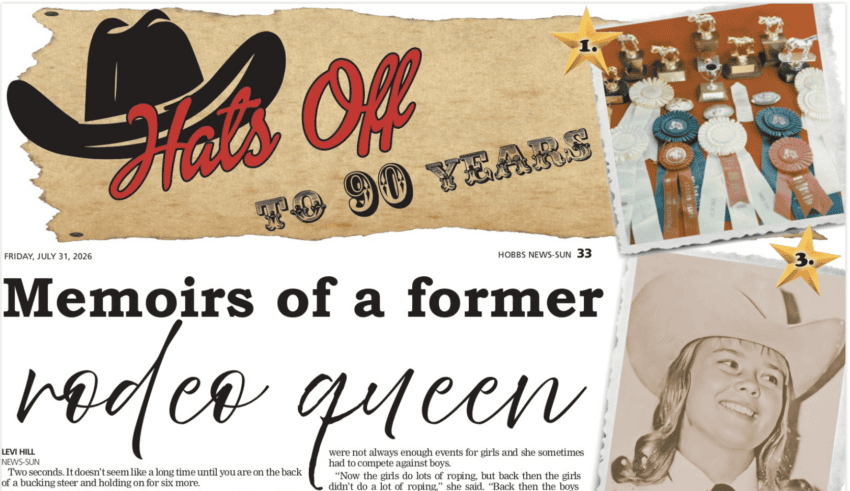
Memoirs of a former rodeo queen
Levi Hill/News-Sun
Two seconds. It doesn’t seem like a long time until you are on the back of a bucking steer and holding on for six more.
For 75-year-old Meloy Hill of Jal, two seconds was all she needed to know bull riding, in this case steer riding, was not for her.
“I stayed on about two seconds, but yep, I rode it,” the Roosevelt County native and former New Mexico rodeo queen contestant said of her one bull riding experience at age 15. “It was scary getting on it and then I had to make up my mind. Men ride with one hand but girls were allowed to ride with two. I chose two. And that ground was hard. I did not enjoy it.”
Hill, who was Roosevelt County Fair and Rodeo Queen 1968, said bull riding is her favorite rodeo event to watch, just not participate in. However, when she was coming up in rodeoing in the 1960s there were not always enough events for girls and she sometimes had to compete against boys.
“Now the girls do lots of roping, but back then the girls didn’t do a lot of roping,” she said. “Back then the boys were riding steers and roping. Girls were doing goat tying, barrels, flag race and poles.”
Back then there was a rodeo event almost every summer weekend somewhere. Very few were nationally-sanctioned events, although some were sanctioned by the American Junior Rodeo Association.
“Most were little town groups that put on the rodeo,” Hill, formerly Simpson, said. “It is pretty much the same today, but it is more organized.”
For Hill, rodeoing wasn’t in her blood. Her family were farmers, not ranchers, but horses were still a part of the farm life.
“Dad had horses,” she said. “We rode all the time. When I was 13 or 14, we were a mile from the rodeo arena and I went down there and started doing barrels. Some people in the community did ‘Little Wranglers’ rodeoing for the local kids.”
Hill was soon doing well enough on her older brother, Mel’s, horse “Scotty” — a 17-hands tall brute — that her parents did something that was almost unthinkable at the time — they paid for gas for another family to take her to rodeo events.
“Then when I turned about 14, the neighbor who lived above us, he was rodeoing too and his dad retired from the post office and decided they would start traveling to compete. Mom and dad talked to them and I went with them. They had a two-horse trailer. Every Friday or Saturday night we went somewhere,” she said.
At that time, in Portales, money was hard to come by. Hill’s father, Melvin, worked for the road department and her mother drove a school bus — something Hill would later do herself — but she also tended a 160-acre farm for extra money.
“We had a huge garden. Mom canned jars and jars and jars of stuff and sold fresh vegetables in the community. Dad worked for the highway department. He ran a bulldozer.” she said. “We were not a commercial farm. We had 160 acres behind the house that belonged to dad’s sister, but then she sold it and that left us with about 40 acres.”
Just why a family with seven children decided to splurge for Hill to chase her rodeo dreams is still a mystery.
“Looking back on it, I wonder why they made that commitment,” she said. “I was five years older than everyone else. If it had not been for the Kingstons, and mom and dad doing that, I would not have rodeoed that much.”
Today, Hill has a display case of rodeo belt buckles packed away in storage, but in order to earn a buckle back then you had to take first place.
“You had to win first place to get the buckle and to get the all-around buckle you had to win more than anyone else. I have quite a few all-around buckles,” she said. “One of them I had to compete against the guys. This one was in Muleshoe, Texas, I had to compete against the boys and I won all-around. It wasn’t necessarily first, but you had to win the most events. I won the most events.”
That was where Hill had to ride a bucking steer because there were no events for girls at the event. She competed against the boys and had to ride steer in order to have enough events to compete for a buckle.
Unlike big events like the Lea County Rodeo today, which spreads events out over several nights, back then all events took place that night.
“I had to rope in that one too. I missed my calf. I think I had to do seven or eight events and we did them all in one night,” she said. “If it was a really big rodeo, it might go two days, but usually they began at 6 p.m. and would go to midnight.”
In 1968, Hill faced just one competitor for the title of Roosevelt County Fair Queen and took the title, earning her a place in Albuquerque to compete for the state title. The Kingston family once again gave her a ride to the event.
“There was a rodeo queen supposedly for every county in New Mexico,” she said. “If you won at state, you got to travel all over the state to different rodeos and mostly handed out trophies. At the fairs you got to hand out not just rodeo stuff, but the kids’ stuff too.”
The state competition was exciting and challenging.
“You had to ride a horse they furnished. You couldn’t take your own horse,” she said. “There were horsemanship competitions and interviews and we got to see lots of famous people and took turns two or three of us would do things for the rodeo each night.”
In her collection is a photo of Hill with three other contestants and country singer Marty Robbins, famous for such ballads as “Big Iron” and “El Paso.”
“He was busy, so he did not pay us young girls a whole lot of attention,” she said.
Although not a cowgirl by birth, Hill said she loved rodeoing, but, as is sometimes the case, life had other plans.
“I loved it. I don’t know what I liked about it. It was better than staying home taking care of the family,” she said. “That summer, after I graduated out of high school, my horse, Scotty got hit by lightning and it killed him. Then I got married. I had a horse after I got married, but it took a lot of money to do that kind of stuff and we didn’t have it.”
When asked if she misses it, Hill said she used to, but at 75 and after two knee replacements, not so much anymore.
“I enjoy watching it, but do I miss it? Not anymore. I think I used to,” she said.
Rodeoing today has come a long way from the 1960s for women, but in some respects, it is still similar.
“It is probably better now because they get saddles and leather tiaras for their hats. We didn’t get that back then,” she said. “It is a big thing now. There is a lot more to it than what I was doing when I was coming up.”
Hill’s last visit to the Roosevelt County Fair and Rodeo was in 2015 and although she wasn’t able to attend the queen competition events, she said the event hasn’t changed all that much.
“The fair was about the same as when I was growing up,” she said.
She hopes to make at least one night of the Lea County Fair and Rodeo this year, if a recent knee replacement will let her. She said she enjoys the arts and crafts exhibits and, of course, the bull riding … as long as she isn’t the one doing it.
Editor’s note: Reporter Levi Hill is the son of Buddy and Meloy Hill.